Cracks sealed. Joints restored. Deteriorated concrete rebuilt in place.
Specialty Grouting Services repairs concrete structures across Ontario — bridges, parking garages, manholes and chambers, tanks, tunnels, and building foundations. Our crews combine crack and joint injection with patching, parging, dowelling, and form-and-pump structural grouting, so the same team that stops the water also puts the concrete back the way it should be.
What concrete repair work does SG Services perform?
- Crack and joint injection — epoxy injection to structurally bond cracks, and polyurethane injection to seal moving or leaking cracks and joints, including on bridges and in parking garages.
- Patching and parging — spalled, honeycombed, or deteriorated concrete removed, prepared, and restored with cementitious repair mortars.
- Dowelling and anchoring — drilled and grouted dowels and anchors for new-to-old concrete connections, ladders, landings, and equipment.
- Form-and-pump structural grouting — formwork set and high-strength or non-shrink grout pumped to rebuild sections, encase steel, or fill under base plates and bearings.
- Concrete coring and drilling — clean, dimensioned cores and drilled holes for injection ports, penetrations, sampling, and anchors.
How do you repair cracks and joints in bridges and parking garages?
Each crack is assessed first: a structural crack that is dry and stable is injected with low-viscosity epoxy to restore the section; a crack or joint that moves or carries water is injected with a flexible polyurethane so the seal survives thermal and traffic movement. Ports are set along the crack, injection proceeds port to port until the resin shows at the next port, and the surface is cleaned and parged. The work is staged around traffic and parking so the structure stays in use. See our Kipling Avenue bridge girder grouting case study for form-and-pump work on a live corridor.
When does a repair need form-and-pump grouting instead of patching?
Hand patching suits shallow, accessible defects. When the loss is deeper, overhead, confined, or has to carry load — a deteriorated manhole bench, an undermined footing, a girder joint, a void behind a wall — we form the area and pump a flowable structural grout so it fills completely with no honeycombing. Material selection follows the specification: non-shrink precision grouts for load-bearing fills, cementitious repair mortars for surfaces, and epoxy where a bonded structural repair is required.
Frequently Asked Questions
Yes. Our crews are confined space entry specialists and routinely complete benching, patching, and injection repairs inside manholes, chambers, vaults, and tanks. See Confined Space Grouting.
Yes. Parking garage leak repair is one of our specialties — cracks, cold joints, and expansion joints are injected to stop water, and damaged concrete is patched, typically while the garage stays open.
Epoxy bonds the two faces of a crack together and restores structural continuity; it is for dry, stable cracks. Polyurethane is flexible and reacts with water, so it is the choice for sealing leaking or moving cracks and joints. We often use both on the same structure.
Yes. We provide concrete coring and drilling for penetrations, sampling, anchors, and injection ports as a standalone service or as part of a repair scope.
Yes. We work to your specification, use the specified or an approved equivalent material, and provide product data and a record of the work for close-out.
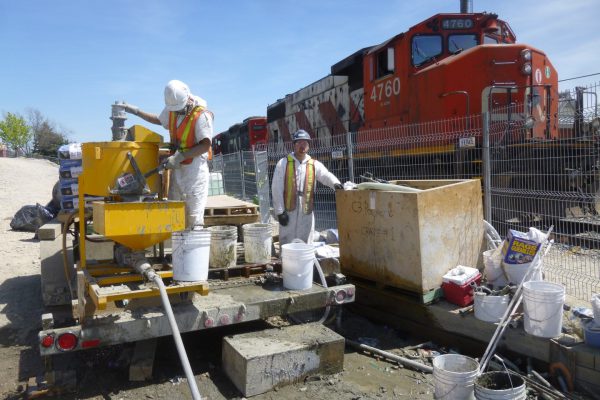 Rail & TransitBox Beam Bridge Girder Grouting — Kipling Avenue, EtobicokeFourteen box-beam girder joints filled with 14,600 litres of 55 MPa non-shrink grout in two days over a live road on the Metrolinx Georgetown corridor.Read the case study
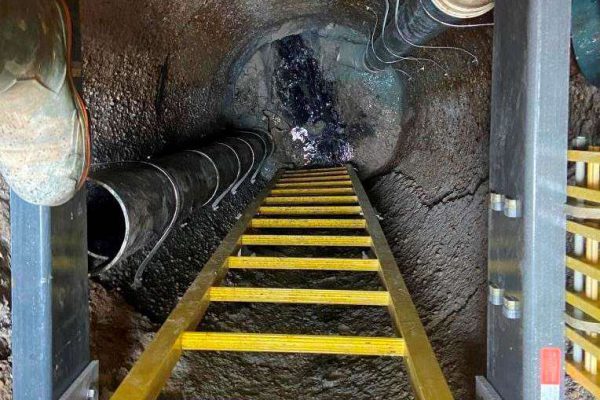 MunicipalSanitary Manhole Ladder & Landing Repairs — Township of Wellington NorthDeteriorated access ladders and landings in two deep sanitary manholes replaced by confined space entry, with the drop pipe secured — manholes safe to enter again.Read the case study
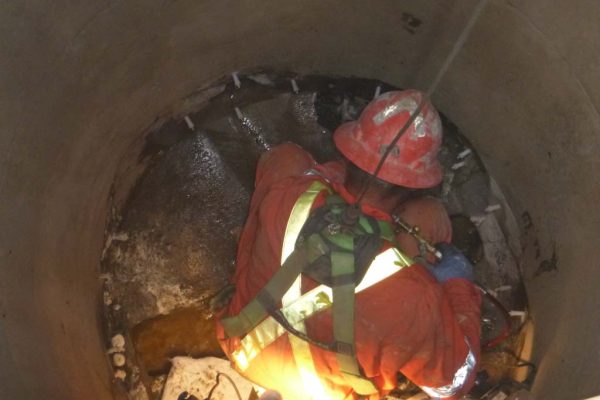 MunicipalSanitary Manhole Leak Repairs — City of WaterlooActive groundwater inflows through joints and pipe penetrations in three sanitary manholes sealed by polyurethane injection — without taking the sewer out of service.Read the case study
Have Concrete That Needs More Than a Patch?
Send photos or the repair specification and we’ll recommend the right method and material.