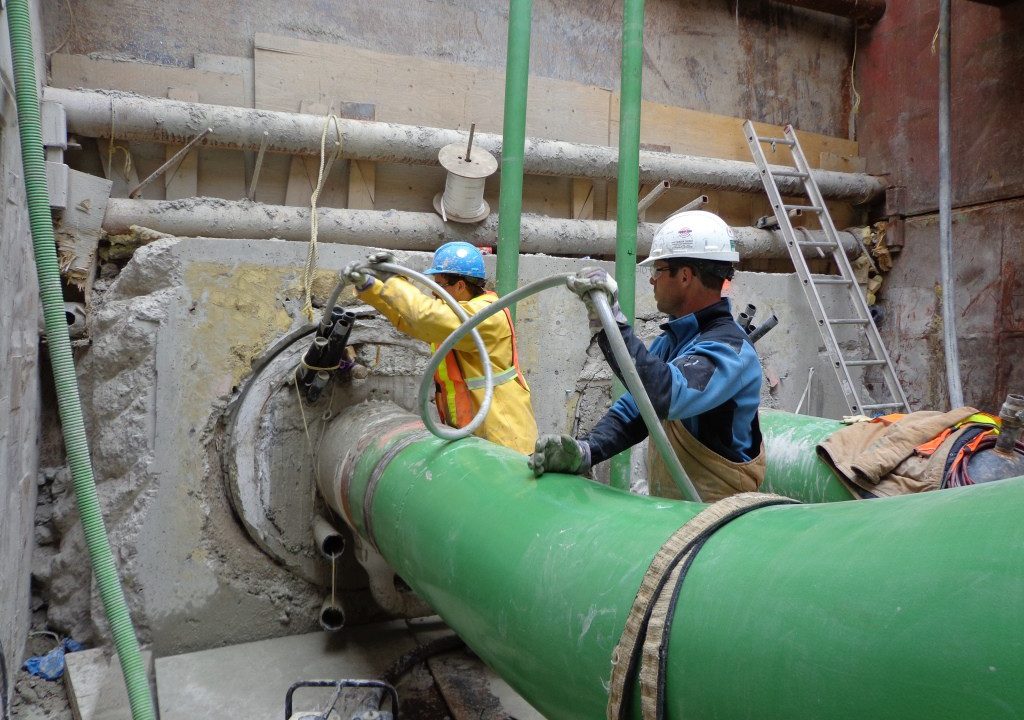
Complete encasement. Verified volumes. Liners protected.
Specialty Grouting Services provides annular space grouting across Ontario, filling the annulus between a host pipe and the new carrier pipe or liner installed inside it. Sliplining rehabilitations, casing crossings, and tunnel liners all depend on this fill being complete — and we place low-density cellular concrete (LDCC) and sanded mixes designed to get there. For lines coming out of service entirely, see pipe abandonment and decommissioning.
What is annular space grouting?
It is the placement of flowable grout into the ring-shaped gap left between an existing host pipe and the smaller pipe or liner installed inside it. Filling that gap locks the new pipe in position, transfers loads to the surrounding ground, and eliminates the open pathway that groundwater would otherwise travel along.
Why does the annulus have to be filled completely?
An unfilled annulus is a void with a pipe in it. Groundwater migrates along it, the liner can float, shift, or deform, and the host pipe continues to deteriorate with nothing to transfer its loads. A complete, void-free fill turns host, grout, and carrier into a single composite structure with a long service life.
How do you protect the liner during grouting?
With mix design and placement control. Low-density cellular mixes keep buoyancy and pressure on the liner down, placement is staged in controlled lifts where geometry demands it, and pressures are monitored throughout. We track volumes placed against the theoretical annulus volume, so you have real numbers behind the word “full”.
Frequently Asked Questions
The main drivers are annulus volume, run length, access point locations, and the mix required. Share the host and carrier diameters, the length, and drawings, and we can price it quickly.
A cementitious grout with entrained foam that makes it light and extremely flowable. It travels long distances through small openings, exerts low pressure on liners, and fills the annulus completely — which is why it is a standard choice for slipline encasement.
Long runs are normal for this work. With highly flowable mixes and planned injection and vent points, extended distances between access locations are manageable — tell us the run length and we will design the placement around it.
Yes. We work to specified density, strength, and flow criteria, and provide mix design data and placement records for verification against the specification.
Placement itself is often quick; the schedule usually depends on access, staging, and volume. Most projects are completed within the window your rehabilitation contractor has already planned.
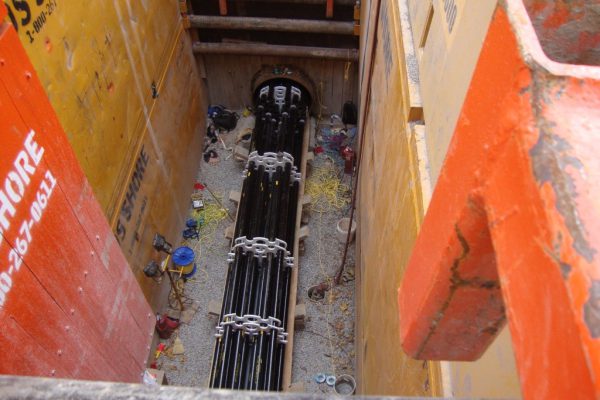 Rail & TransitRail Crossing Casing Annular Grouting — Douro Street, TorontoA 50 m, 1,200 mm casing carrying thirty FRE ducts under the rail corridor filled with 46 m³ of lightweight grout at 20 psi — every duct proven clear on completion.Read the case study
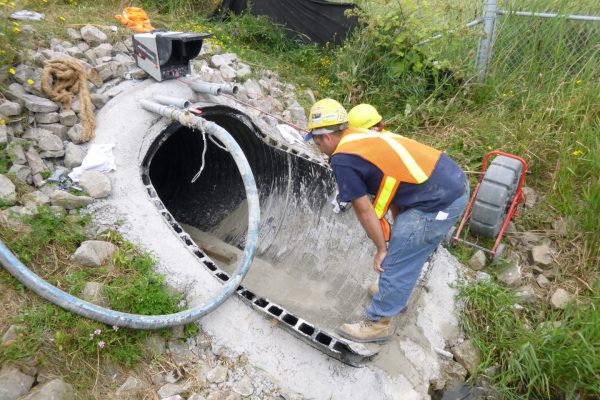 Highways & TunnelsGrout Pipe & Bulkhead Installations — Highway 407 Culvert ReliningStaged, low-pressure annular grouting of sliplined culverts under Highway 407 — grout pipes and bulkheads installed by our crew for a complete, liner-safe fill.Read the case study
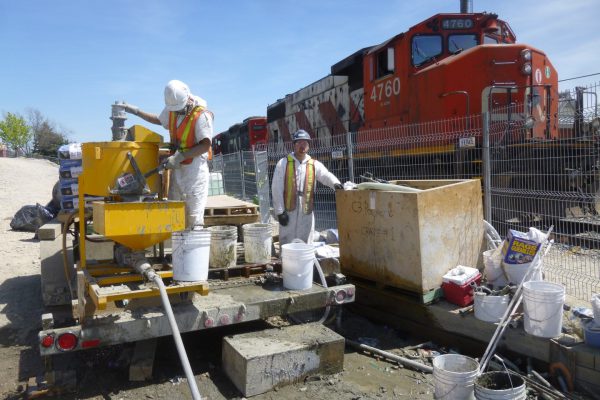 Rail & TransitBox Beam Bridge Girder Grouting — Kipling Avenue, EtobicokeFourteen box-beam girder joints filled with 14,600 litres of 55 MPa non-shrink grout in two days over a live road on the Metrolinx Georgetown corridor.Read the case study
Get a Verified, Void-Free Fill
Send the pipe sizes, run length, and drawings — we’ll come back with mix and placement recommendations.